Based on remarks delivered at the Institute for Global Politics roundtable discussion, “Challenges in Cross-Border Cooperation and Ways to Address Them”
“We need to implement all the necessary programs to pave a smooth path for everyone – for Poles, Slovaks, Hungarians, and Ukrainians. If we do this, it will be an initiative that unites our nations in Transcarpathia”
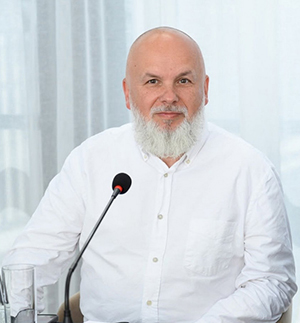
My name is Paweł Bobołowicz; I am a Polish journalist working in Ukraine as a correspondent for Polish media outlets. And although my role now differs somewhat from the line of work of the roundtable participants present here, I will try to represent your country by speaking on behalf of a journalist who has been working in various fields in Ukraine for nearly 35 years.
In this regard, I’d like to share a few of my thoughts that you might find interesting. The first thing I want to say is that although I’ve been working in Ukraine for nearly 35 years, I’ve only begun to actively explore Uzhhorod and Zakarpattia in general over the past two years. For the past two years, thanks to the local residents, I’ve had the opportunity to experience your hospitality. I’ve been living here with my family, with whom I was forced to leave Kyiv – where I had worked for a long time – due to the large-scale Russian invasion in 2022. By the way, when the full-scale invasion began, I took my family to Poland. My wife is Ukrainian, my children are Ukrainian, but we were forced to leave Ukraine, and we missed it dearly in our new place of residence. After some time, we decided to return to Ukraine. To ensure our safety, we chose the city of Uzhhorod as our place to live and work.
I believe I know Ukraine well. I’m even quite familiar with Luhansk region. In 2015, I was with the Ukrainian military near occupied Luhansk… In general, there isn’t a single regional center in Ukraine that I haven’t visited. I’ve been to Crimea countless times and have been to your city of Kharkiv – which I really like – dozens of times, and today I’m worried about the people of Kharkiv who are suffering there right now. But in those pre-war days, I had only been to Zakarpattia twice. You could say that this region was once terra incognita to me. I should point out that there is no information about Zakarpattia or anything related to it in the Polish media. Sadly.
Professor just mentioned joint projects with the Lublin Voivodeship. This makes me very happy, because I myself am from Lublin. It’s my hometown. The Maria Curie-Skłodowska State University there, which cooperates with Uzhhorod National University, is my alma mater. I am also a graduate of that university with a degree in political science, and I am very pleased with this direction of cooperation, particularly the mutual recognition of university degrees. This is a very sound idea.
A few words about the Lublin Voivodeship and its local government, which has recently provided funding through certain programs. This mainly concerns hospitals and the local rehabilitation center, with which your military personnel will be working. This is also made possible thanks to the European Union, which works in this area through our Lublin Voivodeship. We can also mention the initiatives regarding the botanical park in Uzhhorod, which are being implemented thanks to cooperation with the Lublin Voivodeship. All of this is heartening. It cannot be said that this is a trivial matter, as significant funds are being allocated to it. Today, Zakarpattia region has great friends in Poland, among whom, I believe, we can count Zbigniew Wojciechowski – a well-known Polish politician. He served as Vice President of Lublin and was a member of the Polish Sejm. Anyway, I believe that a great deal of relevant information can be provided on this topic, which will be useful for establishing cross-border cooperation.
There is a great deal of information here about a very important factor related to cross-border cooperation: the border. We understand that there are quite a few problems at Ukraine’s border with the European Union. And unfortunately – and this is very sad – it must be said that these problems generally arise on the European Union’s side. I can say this because I cross that border several times a month. There have even been times when I crossed the Polish-Ukrainian border four times in a single day. It was necessary. I’m well aware that, unfortunately, most of the problems are related to the European Union. And very often this is due to a mindset that’s quite unpleasant. In such cases, it’s hard to talk about establishing effective cooperation. In fact, when you have to stand at the border for two or four hours just to get to the other side, it’s unpleasant. But the worst part is that you don’t know how long you’ll have to wait to cross. It might be that you’ll cross in about twenty minutes – which is longer than it currently takes to cross the border with Slovakia. Or you might have to wait as long as six hours. And there’s no logical explanation for this. One can only wonder…
And I’ll say it again: I love Ukraine very much. But seriously, I’m speaking very objectively here: there is a procedural problem. And it stems from the European Union, not from Ukraine. Yes, there have been the delays mentioned on Ukraine’s part – these things happen. But this problem mainly concerns the European Union. If it isn’t resolved, any cross-border cooperation will be problematic. In that case, a businessman will say, “Why should I go through all these hassles? Why should I have to stand at that border and answer all sorts of questions about bribes and the like?” Unfortunately, there’s no getting around this today. To some extent, this can also be observed on the Ukrainian side.
On the other hand, it is stated here that the issue of tourism is less important. I believe that for Poland, the issue of tourism in Zakarpattia is precisely an important one. One could even say that it represents the future. But spending time standing at the border… I understand the situation Ukraine finds itself in right now. Ukrainians are also disappointed because they cannot travel abroad. There are numerous administrative and attitudinal issues here.
For a long time, I couldn’t understand how anyone could live in Kyiv. Once I started living there, I ended up staying for 10 years, and only then did I begin to think it was the most beautiful place in the world. Well, I love the Ukrainian Crimea – it’s also a special place for me. I really love Ukrainian Bessarabia. But right now, I have such a positive view of the Carpathians. Every day, the Carpathians fill me with awe. It’s an enchanting region. Just imagine: quite a few guests come to our home throughout the year. This has been going on for two years now! Up to 100 people visit us in a single year. Some of them are Ukrainians who come from different places. Whether for business or just to relax. There are many Polish guests who’ve never been here before. They’re thrilled by what they see. Not a single one of them has said they didn’t like it here.
Guests are fascinated by the architecture, nature, and health resorts. But here again, a problem arises, which I’ll say a few words about. I really love Slovakia, but to get from Poland to the Ukrainian region of Zakarpattia, you have to drive through Slovakia. However, there needs to be a suitable road, which doesn’t exist. But thanks to potential cross-border cooperation between Poland, Ukraine, and Slovakia, this problem can be resolved.
Every year, an event called “Good Neighbor Days” takes place in Lublin region. In terms of its spiritual dimension, this is organized by Father Stefan Batruch, a Greek Catholic priest from Lublin. Every year, for a few days, the border opens at a spot where two Old Ukrainian villages are located side by side. There’s no river there – it’s just a spot on the border with Ukraine where a huge number of people gather for a few days. This event brings them together; a festival takes place.
There was a festival like that last year, too. I go there regularly. For Poles, it reveals some truly wonderful local gems. Our part of the Bieszczady Mountains, this part of the Carpathians. Well, you all probably know about the events that took place there in the past – about the communist crimes during Operation Vistula, when all the local people – Lemkos, Boykos, Ukrainians – were rounded up and deported to distant territories. No one from the local population remained there. But “thanks” to this communist crime, the beautiful natural landscape has been preserved in these areas. However, here you can’t see what this territory would have looked like had the communist crime not taken place.
As for the neighboring Slovak territory, it’s sort of an add-on, but it also has its own unique features. And when you arrive in these places, look around, and you might find yourself thinking: Isn’t this the pearl of Europe? It’s an enchanting region. Of course, tourism comes to mind, but there are other things to consider as well. But if you try to drive through this region, it would be a thousand-kilometer journey across all these countries. You’d simply give up the idea. And this small example illustrates how we need to implement all the necessary programs to open up this convenient route for everyone – for Poles, Slovaks, Hungarians, and Ukrainians. If we do this, it will be an initiative that unites our countries in such an interesting place. It will be a tangible example of cross-border cooperation.
I’m very impressed by Zakarpattia – that’s true. If I were a TV journalist rather than a correspondent for Polish Radio, I could visually confirm my impressions.
Paweł BOBOŁOWICZ,
Polish journalist, Wnet Media correspondent in Ukraine,
head of Radio Wnet’s Eastern Editorial Office, co-founder of Radio Unet,
co-founder and editor of Stop Fake PL